
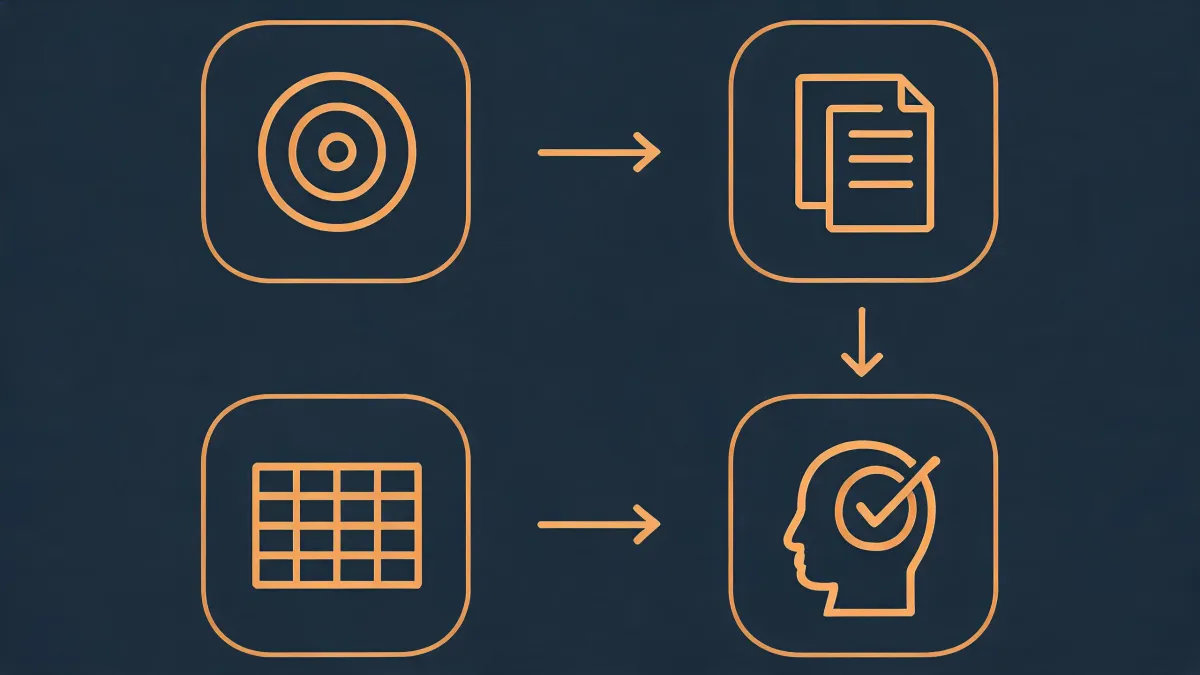
Here's the thing about agent-native prospecting: everyone starts with the same question—how much human review is enough? Not because anyone wants a slower sales motion, but because we all have this nagging sense that letting an agent run unsupervised is inviting the sort of problem you only discover after it's scaled.
If that sounds like you, stop. It's the wrong first question.
The right first question: where do agent-native workflows actually fail? Once you map the failure points, the human-in-the-loop conversation stops being a trade-off between speed and safety. It starts looking like what it is: a quality gate on the one thing that matters—your decision logic.
I learned this the expensive way in February 2024, when I let an agent run a prospecting campaign almost entirely on its own. It sent 3,700 emails. We got 15 replies. And 1,400 of those emails were built on the same slightly-wrong record type I'd told the agent to trust. I'm gonna walk you through what broke, what it cost, and the four-gate checklist I've used ever since.
The Surface Problem: “If I Still Have to Review Things, Why Do I Need an Agent?”
I get it. If you're building an agent-native workflow, the whole pitch is that repetitive work gets automated. The moment someone says “human-in-the-loop review,” it feels like the repetitive work is back on a human.
From the outside, it looks like HITL review is friction. The reality? Lack of review is the friction—it just shows up later, disguised as rework, bad replies, and nine hours of data cleanup.
To be fair, the tension is real. But it's not the actual problem. The actual problem is that most teams put human review in the wrong place.
Where Agent-Native Prospecting Actually Breaks
I've been running GTM and RevOps for B2B software companies for eight years. In my first year—2017—I sent a campaign to 800 records with a broken merge field. Wrong titles, wrong greetings, a week of apologies. That cost us $3,200 and taught me to check my list setup. I thought I'd learned the lesson.
That was nothing. In February 2024 I automated the same lesson at scale. That's the uncomfortable truth about agent-native workflows: they rarely invent new failure modes. They take your old ones and give them a productivity boost. Same mistake, faster.
So where do they break? In my experience, three places.
1. Agents fail consistently, not randomly. The most frustrating part of working with agents is they will not second-guess the match score, and they will not notice when an ICP description feels slightly off. A human SDR will unconsciously self-correct—they might not even know why, they just skip the weird account. An agent applies your interpretation of the rules, perfectly, to every record that matches. Which means a small error rate is not a small error. If the matching logic is wrong at 4%, those errors are all the same error. I once pulled a log where 43 consecutive emails had gone to the wrong person, because I'd mapped contact names to pull the company owner instead of the decision-maker. Same mistake. Forty-three times. A human team would've caught it by the third email. The agent just got faster.
2. A data error is not an event; it's a state change. This one surprised me. A single bad email is an event—you apologize and move on. But an agent-enriched record synced to your CRM? That's now part of your database. Your segments are wrong. Your lead scoring is wrong. Your next campaign starts from polluted data and you won't know until you compare results to reality. In that February 2024 run, the agent overwrote the “Industry” field for 1,400 accounts with a parent-company classification nobody asked for. It took six weeks to notice. You cannot unpollute a CRM by apologizing to it. You pay someone to fix it, and that never makes it into the ROI model.
3. Compliance exposure multiplies instead of adds. Not legal advice—talk to your counsel. But ours drilled these in: per FTC guidance (ftc.gov), commercial claims have to be truthful and substantiated, and under the CAN-SPAM Act (which the FTC enforces), commercial email must have accurate header information, a working opt-out, and a valid physical postal address. A trained SDR builds those requirements into their habits. An agent generates 10,000 variants from your template, and nobody has checked each one. Add GDPR or CCPA into the mix, and one wrong record processed through the wrong logic becomes a problem that scales with your send volume, not your intent.
Agents aren't the problem. Unreviewed decision logic is.
What a Three-Week Unsupervised Run Cost Us
Here are the real numbers, because I think they matter. February 2024. I configured a workflow that would:
- Pull 3,000 accounts from our CRM, Sales Navigator lists, and data providers that matched our Tier-1 and Tier-2 ICP filters.
- Enrich each record with contacts, emails, and phone numbers via our enrichment tool's sources.
- Draft a personalized first line using a template + firmographic data.
- Auto-send whenever the email confidence score was above 72%. Anything below that got queued for human review.
Seems reasonable, right? 3,000 records is too many for manual review, so a confidence threshold looks like the smart way to scale. I pitched it to our CEO as the “safe” version of outbound automation. Oof.
After three weeks: 3,700 emails sent, 15 replies. That's a 0.4% reply rate; a decent cold campaign runs 1-3%. We also had 214 bounces and 3 spam complaints. If it had been a one-off mailing, I'd have called it bad luck.
The surprise wasn't the low reply rate, though. It was how uniform the failures were. I pulled the log and sorted by outcome. 1,400 emails had gone to the wrong person at the right company, and the confidence scores for those records sat between 73% and 82%—just above my magic threshold. The enrichment had matched first names across two similarly-named companies, and the verification tool happily confirmed the address as deliverable. It looked real. It was not.
The financial damage: $4,800 in tool spend, roughly 160 hours of cleanup before we could run another campaign, and an 11-day gap where outbound went dark because nobody trusted the pipeline. The CRM fix alone took a data analyst three days. I haven't even priced the domain reputation hit or the trust lost with leadership.
Total cost of that run: about $11,500 in hard spend and team time—to send emails that should never have gone out. The most frustrating part? The agent did exactly what I told it to do. The failure wasn't the tool. It was my definition of “review.” I'd set up a human-in-the-loop that only looked at the records the agent rejected. The records the agent approved? Nobody looked at them. Not once.
“I do not blame anyone for making the same call. I made it myself. But a human-in-the-loop whose only job is to rubber-stamp the agent's ‘yes’ is not a control. It's a receipt.”
So How Does Human-in-the-Loop Review Fit into an Agent-Native Prospecting Workflow?
Short answer: as a checkpoint on logic, not a checkpoint on every output.
The fix isn't to go back to reviewing 3,000 records one by one. The fix is to realize that the agent doesn't need a supervisor for each action; it needs a reviewer for the criteria behind those actions. Once I stopped reviewing outputs and started reviewing the decision logic that produced them, everything got faster. Not because the agent sped up—because I stopped burning time on things that didn't matter.
Here's the four-gate checklist I maintain for our team now:
- Review the criteria before you run, not the data after. Re-read your ICP definition, segmentation logic, and source selection. Agents inherit your criteria; if they're fuzzy, your output will be fuzzy. It's a 15-minute read that saves you from a 3-week mistake.
- Review the threshold edges, not the average. Don't sample random records. Export the 100 records closest to your confidence threshold and look at them. If the margin looks like ours did—uniformly bad—your threshold is wrong. We discovered our 72% cutoff was effectively a “send to wrong person” button for everything between 73% and 82%.
- Route exceptions to humans instead of letting the agent decide alone. The workflow builder should let you design for “maybe.” Ambiguous records go to a review queue, not because you'll check every one, but because the agent's uncertainty is where your learning signals live. A human should see every exception. That queue is your early warning system.
- Audit a small rolling sample end-to-end. Once a week, grab 25-30 records from a completed batch and trace them: list → enrichment → email → CRM fields. You're not hunting individual errors; you're looking for pattern changes. Did a vendor merge a category? Did a segment drift? Boring habit. Catches things before they become board-slide surprises.
Take this with a grain of salt: this checklist has caught 47 potential workflow errors for us in the past 18 months. I don't have a precise dollar figure for what it saved, but I know exactly what the alternative costs, because I paid for it.
Granted, this means the agent doesn't run completely unattended. That's the point. Agent-native should describe the workflow, not the decision-making. The agent does the repetitive work; the human does the judgment work. If you reverse that, you'll scale your own bad judgment faster than you can apologize for it.
And when you're evaluating tools—whether you're looking at Clay's workflow builder, a GTM alternative, or an in-house stack—ask the questions that expose friction. Ask how exceptions surface. Ask whether the builder assumes a human will review logic before a batch goes out. Ask how a bad batch gets caught, not just how a good one gets sent. The vendor who shows you all the friction points upfront, even if the demo feels longer, is probably the one that costs less in the end.
I've personally made six significant mistakes running GTM and RevOps teams, totaling roughly $42,000 in wasted budget, and I now maintain our checklist so others don't have to repeat them. The four gates above are a good start.
Run the agent fast. Review the logic slow. That's it.