
Here's the short answer before anything else: a spam checker belongs inside the agent loop, not after it. People keep asking me the same thing: how does spam checker fit into an agent-native prospecting workflow? It belongs between enrichment and outreach, as a conditional gate. I didn't think that way in 2023. That mistake cost me about $8,400 and a lot of credibility with our sales team.
That's not a number I'm proud of. It's the reason I now document every prospecting workflow like a checklist, and it's why I use total cost thinking before I buy any data or enrichment tool.
Why You Should Listen to Me
I've been in GTM operations for seven years. I've personally made—and written down—14 significant data mistakes, totaling roughly $34,000 in wasted budget. The March 2023 disaster was the biggest. Since then, I maintain our team's data quality checklist so other people don't repeat it.
This isn't a Clay pitch. I use Clay because it fits how we work, but the lesson applies to any enrichment stack: speed without a quality gate is just a faster way to make a mess.
My $8,400 Mistake and What It Taught Me
I didn't fully understand the value of a spam checker until a $900 list turned into an $8,400 nightmare.
What I did
In March 2023, we needed to generate leads for a new outbound campaign. Our sales team wanted more contacts, and they wanted them fast. I found a list vendor selling 5,000 freshly verified contacts for $900. It felt like a shortcut.
I loaded the list into Clay. I used Clay lead enrichment to add company size, technology signals, and intent data. I enriched every single record. Then I pushed everything into Salesforce and our sales engagement tool.
I skipped the spam checker step. I thought it was a final QA checkbox, something you run once at the end. I've changed that view.
What happened
We didn't have a formal pre-send verification process. That's why a bad list made it all the way to Salesforce.
The list was fresh in the sense that it was scraped recently. It was not verified in the sense that the emails worked. On the first send, we saw a 23% bounce rate. Most email deliverability guidelines treat a bounce rate above 2-3% as a red flag for sender reputation (Source: Google Postmaster Help and Microsoft sender guidelines, as of early 2026; verify current thresholds). We blew past that in one afternoon.
Our email provider threatened to block our domain. IT spent three days working on reputation cleanup. Salesforce was full of records with bad emails and enriched firmographics attached to them. Cleaning that took another two weeks.
Oh, and I should add that the vendor's quote did include the words may not be deliverable. I didn't read that when I signed.
The total cost, counting list price, wasted enrichment credits, ops time, and cleanup labor, landed at roughly $8,400.
The counterintuitive part
The $900 list wasn't actually the biggest mistake. The bigger mistake was enriching before verifying. Every bad email triggered enrichment, so every bad email consumed credits. Every bad email got written into Salesforce with a company profile and intent signal attached. That made the cleanup harder.
I now run spam checking before enrichment for newly discovered emails. That sounds obvious in hindsight, but a lot of agent-native workflows still do it backwards because the agent is easy to set up and hard to interrogate.
Where a Spam Checker Fits in an Agent-Native Prospecting Workflow
The old belief is that spam checking is for beginners or for list hygiene at the end of a campaign. That comes from an era when a sales rep manually copied 50 emails from LinkedIn. Once an agent can generate leads and enrich data at scale, that logic breaks.
Agent-native prospecting means the agent makes decisions about sources, matching, enrichment, and routing. A spam checker is one of those decision points. It should be a conditional branch inside the agent loop, not a separate task that a human remembers to do.
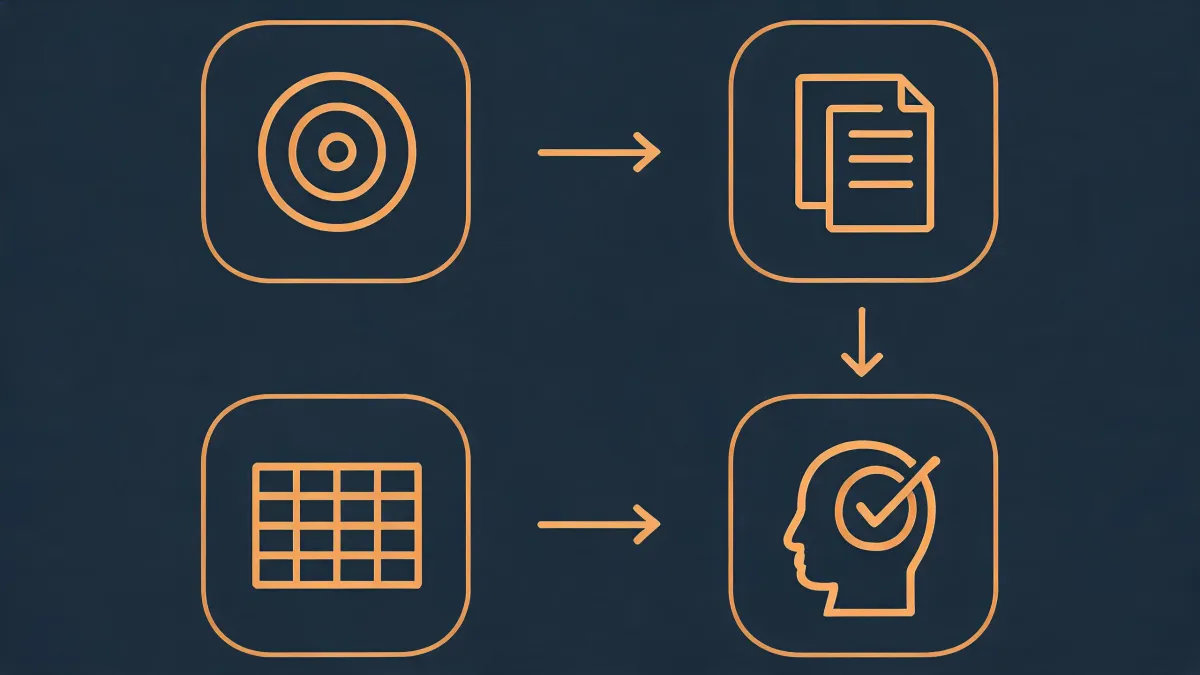
Here's the sequence we use now:
- Generate leads from inbound forms, CRM gaps, and intent data.
- Run Clay lead enrichment to append missing firmographic and technographic fields.
- Find email addresses with an email finder step.
- Run a spam checker on every discovered email before it can enter Salesforce.
- Push verified records to Salesforce. Flag high-risk records for human review or route them to a different outreach channel.
The important part is step 4. If the spam checker marks an email as high-risk, the agent doesn't delete the lead. It changes the next action. That's what makes it agent-native: the checker isn't a report someone reads later. It's part of the system's behavior.
Using Clay Data Enrichment for Salesforce Without Polluting Your CRM
Salesforce is where dirty data hides. If you let every enriched record flow in, you're building a landfill, not a pipeline. I use Clay data enrichment for Salesforce as a gate: no record gets updated until it passes the quality check.
We keep a deliverability score field in Salesforce and a do not auto-enrich flag. If the spam checker gives a bad score, the agent leaves existing data alone. It doesn't overwrite a good phone number with a bad email.
Clay can enrich data in seconds. That speed is useful, but it cuts both ways. If the email at the center of a record is wrong, you're enriching a fiction. The data doesn't become true just because 10 tools agree on it.
Why Total Cost Thinking Changed My Budget
Before March 2023, I compared line items. A $900 list looks better than a $3,000 list. A $100/month spam checker looks like an unnecessary subscription. Now I calculate total cost of ownership before comparing anything.
TCO for a prospecting workflow includes:
- List purchase price.
- Enrichment credits spent on records that fail later.
- Sales ops time building, fixing, and re-running workflows.
- CRM cleanup time after incorrect records are synced.
- Email domain and sender reputation damage.
- Sales team trust, which is the hardest line item to recover.
The $100/month spam checker now looks like the cheapest item in the stack. In the first week, we caught 47 records that would have bounced. That paid for the tool on its own.
That said, I'm not saying every cheap data source is bad. I'm saying you can't judge one until you know what it costs at the end of the workflow. This is probably true for most data decisions.
Where This Logic Doesn't Apply
A spam checker is not a silver bullet. If your team only prospects into first-party, opted-in leads that salespeople collected themselves, you might not need it. If you send tiny volumes from a domain nobody depends on, the risk profile is different.
Spam checkers also make false-positive mistakes. They can flag catch-all addresses that might actually work. They can't predict inbox placement. And no checker can turn a rotten source list into a good one.
I also don't believe Clay, a spam checker, or any tool can guarantee a reply rate. That would be a lie. What a good workflow does is remove the avoidable failures so your team's message actually reaches someone. After that, you still have to write something worth reading.
That's where I land today. If you set up an agent-native prospecting workflow, put the spam checker in the middle, not at the end. It's cheaper than the cleanup, and my checkbook can prove it.